



The intake form asks me to describe my injury in my own words and gives me three lines to do it. I have been describing this injury for almost two years, to doctors, to adjusters, to my attorney, to the version of myself that keeps the official record. Three lines is more than I need. I can do it in one.
The evaluation turns out to be plural: a pre-assessment, then days of testing, then meetings to discuss the testing, spread across the calendar like a treatment plan for a condition nobody has named. The insurance company will want proof, my attorney says, and when the injury lives inside your head, this is what proof looks like.
I go prepared, because preparation is what I do now. I bring the folder I have kept since the accident: the imaging, the appointments, the therapy notes, my recovery in chronological order.
I am a historian.
The Baseline
The pre-assessment is a written assessment first, pages of it, and then an interview that ran for hours. The questions cover three versions of me: who I was before the accident, who I was right after, and who I am now (which, ya’ll, is essentially who you “think” you are… remember, you are talking to a psychologist).
Then they keep going, past the injury entirely. My childhood. My education. My sleep, my work, the hard years I do not usually hand to strangers. The neuropsychologist writes while I talk. He is building a baseline, he explains, a portrait of the person before, so the tests can measure the person after.
When I ask why it has to reach so far back, he is direct about it. The other side will ask, so he has to ask first. Every part of my personality has to be accounted for, and every part of my medical and psychological history with it, because every part of me will be on trial.
I came in as the historian of my own body. The job turned out to be larger than that. I am the historian of my full history now, the trauma included, the lore of who I am and why, deposed into a stranger’s notes because someone I will never meet is preparing to read them against me.
I am good at this part. I have told the story so many times that it comes out clean, in order, with the dates attached.
He nods and writes. I mistake the nodding for agreement.
The Sheet of Paper
The testing days belong to a different man, younger, with a script he is required to read, with exactness, and a timer he is required to run. That timer still haunts my dreams sometimes.
The tests start small. Replicate this picture. Then draw the figure from memory (?!?!). Repeat these numbers backwards. Sort these cards until the rule changes and notice, without being told, that it changed. Some of it feels like games, and through the first morning I hold my own, or believe I do, which I will learn is a distinction that matters.
The worst test of the day comes just after midday. A single sheet of paper, rows of words that are all names of colors, some printed in black and some in ink that argues with the word it spells. The administrator reads the rule from his script, say the word here, say the ink color there, and starts the timer.
For a few seconds I am fine, and then something in me panics. The word is there, the color is there, the rule is there, but whatever carries one to the other stops carrying, and I hear myself stutter.
I know this stutter. It has lived in me since the accident, though I *thought* we had a contract: a crowded room, a day of overstimulation, real stress. Apparently, it does not need any of that. It needs a piece of paper. It comes on whole, like a CD skipping entire tracks, sounds dropping out of the middle of words while my mouth keeps moving.
My throat tightens and my hands find the edge of the table as if the table is the thing that’s moving. My whole body organizes itself around the production of single syllables. Red. Blue. Green.
The administrator watches. He is not permitted to speak until the test ends, and his face has gone to a trained neutral, pleasant all morning, smooth now, while that dumb timer runs.
By the second sheet I am crying, and the migraine climbs until I have to ask for a break in a voice I do not recognize as the one I walked in with. Finishing takes fifteen more minutes for something that should have taken three.
Primary colors on a sheet of ecopaper.
My body understood the terms better than I did. The table gripping, the throat constriction, the tears, my whole system responding to this task the way I thought it reserved for the worst days, because to the injury there is no difference. I had been keeping careful records of my recovery, including where my limits sat and what it took to reach them.
My body had been keeping its own the entire time.
The Drive Home
I drive home in the slow lane with the radio off.
When Luis asks how it went, I start the sentence twice before it comes out, and we both hear it, and neither of us says anything about it. The dogs treat me exactly the same as they did yesterday, which helps more than anything with words in it.
The Weeks
The testing ends and the report begins somewhere out of sight. My body takes two weeks to come back.
Migraines, one after another. Stress and anxiety with nowhere to put themselves. A fog so heavy that words go missing on their way to my mouth again. I feel terrible in a way I recognize but had tried to forget… because this is how I felt in the days right after the accident. The evaluation built to measure the injury has reproduced it. For two weeks I am living inside the very proof they are writing up, before the report exists to say so.
When the fog lifts, the waiting begins in earnest. A man I have met twice is scoring my brain against a table of norms while I go back to work and practice and the ordinary running of a life. I catch myself performing wellness in the meantime, as if the report might be watching.
The waiting has an almost specific… texture, maybe? It is the texture of having given testimony and not knowing yet whether you are a reliable witness for yourself.
The Neuropsychological Verdict
A few weeks later I am in his office, nervous, because I do not know what his verdict will be.
Which is its own strange sentence to hold. It is my brain. I lived every day of the recovery. If anyone knows how far I have come, it should be me, and still I am sitting across a desk waiting for a stranger to tell me.
The report is thick. He does not hand it to me right away.
I hate to be the bearer of bad news, he says, but your brain has been gaslighting you. You have not recovered as much as you think you have. What you have done is accommodate your new disabilities, so thoroughly that you do not realize you are doing it.
He keeps talking, scores and percentiles and domains, but I stay behind at that sentence for a while.
Gaslighting. A word for a relationship in which one party controls the record and the other learns to doubt their own account. Except here, both parties are me. The historian and the archive, and the archive was forged, and the forger meant well. My brain routed around its damage so smoothly that it filed the detours as recovery. Every accommodation got recorded as a healing. I read my own chart every day for two years and believed it.
Healed, unhealed. I had been writing the first word in the record while the second one was true.
The Record
The evaluation was overkill, days of it, a bureaucratic gauntlet built for a lawsuit. And it is also the only process that told me the truth. The people who love me confirmed the official version because they wanted it to be true as much as I did. It took a man with a script and a timer and a sheet of primary colors to reach the actual record, and it cost him nothing to read it to me, and it cost me the story I had been living in.
The report went to my attorney, who was pleased, because it was exactly the documentation the case needed. Proof, he called it. What is evidence to them is a diagnosis to me, the same pages doing two jobs at once. Somewhere in an office I will never see, the insurance company received its copy and begins looking for a doctor who will read the same record and disagree.
If you are living in a body that has quietly accommodated something you filed under finished, and you are afraid of what an honest accounting would show, I want to tell you the thing I am still learning to hold.
The accommodation was not a lie told against you. It was your body carrying what you could not carry while you got on with living. The record was wrong and the living was real. Both stand.
You are allowed to find out you are less recovered than you believed.
You get to keep the recovery you actually made.
-Alex 🧡
Part four - there is another evaluation coming, the insurance company’s this time, a doctor hired to read everything I just handed over and reach a different conclusion.
This one was a gift. That one is not.
—
Read part one here.
Read part two here.
About Alex
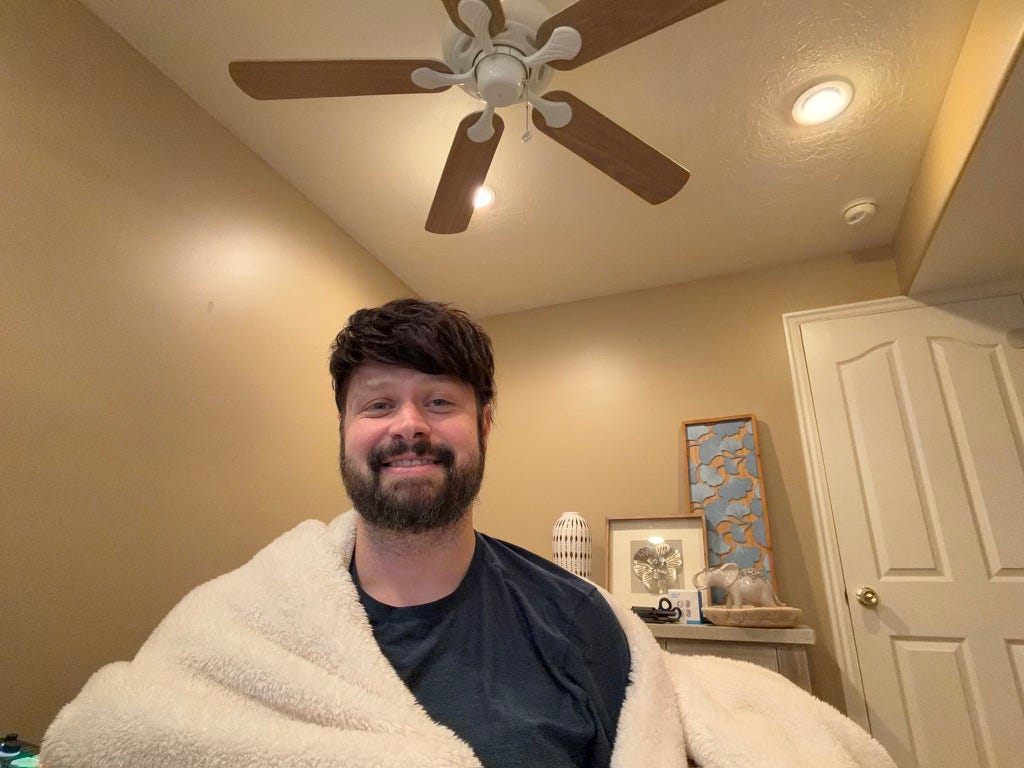
I’m Alex Lovell, PhD — political psychologist, yoga therapist, and the founder of a made-up institution called The Department of Aliveness.
By day I’m a VP leading global research on what makes people come alive at work. I love it. By every other random hour I’m here — writing, facilitating, and walking beside people who are figuring out what it means to be alive after everything shifted.
I’ve been homeless. I’ve been divorced. I’ve had my brain rewired by a semi-truck and my life rearranged by things I didn’t choose. I’ve also been surprised by how much aliveness was waiting in the wreckage — not because suffering is a gift, but because I stopped waiting to be healed before I started paying attention.
I’m on a mission to remind one person a day that the life they’re living is the one that counts.
Oh…Alex… this had to be a shattering experience for you. Being confronted with tasks that stripped an illusion of healing… being thrown back in time to post accident headaches, areas of dysfunction in processing and emotions… At the same time the results are what you need for your lawyers. And you are not done yet. Brains are interesting organs because when new pathways are created it can help you function at a higher level… at least when not overstressed. Learning to find the balance is also a part of your healing journey. I’m confident that unwanted symptoms will diminish as your overstressed body finds inner balance and peace. 💞
Many compassionate ((hugs)) from afar my friend.
I wish that there was something we could do to support your journey. I’m glad Louis is there to remind you that no one other than you gets to tell you who you are.