


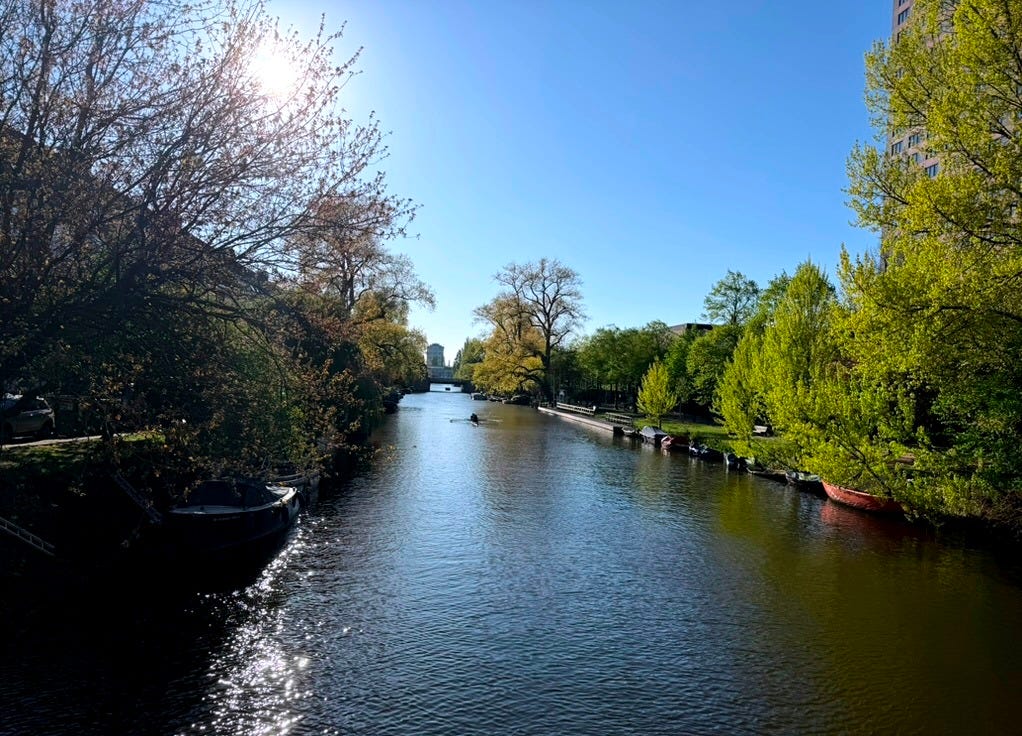
The wine arrived before I had decided whether to read or to listen. The pub had six tables crammed into a room built for four, and my elbow was nearly touching the elbow of a woman at the next table over, and I had brought a book the way I always bring a book, and the book was open in front of me, and within ten minutes I knew I was not going to read a word of it.
I had come in to be alone. The people in the pub had other plans.
It was my last night in Amsterdam. The kind of evening I usually like, where I do not have to translate anything or decide anything or be anyone in particular. Just a body in a chair with a pie on the way and a glass of red I had not yet touched.
The conversation at the table to my left turned political about the time my food arrived. A woman in her sixties, halfway through what I suspected was not her first glass of wine, was naming things about my country with a precision I could not argue with, even if she had been talking to me, which she was not.
The man across from her, quieter, said one sentence about a person he used to know and put his fork down. Grief, the kind that does not need volume.
Behind me, a younger pair were jubilant about something the woman in her sixties was furious about. Their voices were bright and a little loud in the way voices get when you are sure you are right and you are also sure the room agrees.
To my right, a couple in their thirties were arguing about whether to be furious or to stop reading the news for a week, which is its own kind of grief.
And me. In the middle. With a book I had stopped reading and a wine I had started drinking and a body that was registering all of it at once, the way a microphone registers everything in a room without choosing.
For more essays about attention, aliveness, and the rooms that teach us things we did not go looking for, you can subscribe here.
Then They Noticed Me
The thing about being the only American in a room full of strangers talking about America is that eventually someone notices.
The woman in her sixties was the first. She glanced over at one point, mid-sentence, and then leaned slightly toward my table and asked, with the kind of warmth that is also a small invitation to fight, what I made of it. As an American. Surely.
I smiled. I said I had not really thought about that. Which was a small lie, the social kind, the kind we use to keep our dignity and theirs at the same time. I had thought about it. I just was not going to give it to her.
She accepted the lie graciously. Went back to her conversation.
The jubilant pair behind me tried next, about twenty minutes later. Their version was friendlier. They wanted me to share their happiness about the thing they were happy about. Wanted confirmation, I think, that they were not crazy to feel what they were feeling. I told them I could see why they felt that way. Which was true. I could. I just was not going to feel it with them.
The man with the grief did not try to recruit me. He was somewhere I recognized. He needed nothing from anyone.
The exhausted couple to my right asked me, around the time the pie arrived, whether I read the news. I said I did. They asked how I lived with it. I said I was still figuring that out. Which was the most honest thing I said all night, and also the thing that ended the conversation, because nobody at a pub on a Thursday wants to hear that you are still figuring it out. They want you to have an answer. So they can argue with it, or agree with it, or feel less alone in their own.
I did not have one.
What I Did Not Do
I did not argue. I did not catch the woman’s eye and apologize for my country, which I have done at international tables for years and had grown tired of doing. I did not perform sophisticated detachment (and let me tell ya, I can detach very sophisticatedly when I want to). I did not put my book up like a wall. I did not tell anyone what I actually thought.
I sat there. I enjoyed my food. I eavesdropped. I did actually read my book. Cut my pie. Drank the wine. Smiled when I needed to smile. Said the small social lie when it kept the peace. Was complimentary about perspectives I did not share and noncommittal about ones I did. Listened.
Something in me was online but quiet. The watcher was on. The watcher was not narrating. The watcher was just there, registering the woman’s fury and the man’s grief and the jubilant pair’s certainty and the exhausted couple’s question, all at once, none of them collapsing into the others, none of them pulling me in.
Ten years ago I would have argued. Five years ago I would have apologized. Two years ago I would have left.
I did none of those things.
What Did Not Earn It
I want to tell you what I think I was doing instead, since I think it is what a lot of us are trying to figure out right now and do not yet have language for.
To participate, without being participative.
To be present, without giving all of your presence.
These were important conversations. These were important experiences. They had not earned my activation. Only my interest, and my witnessing.
I have been thinking about that sentence since I wrote it down on the flight home.
The thing about activation is that it gets extracted from us all day long. The news, the feed, the headline, the email, the text from the friend who needs you to be furious with her about the thing she is furious about. The pub, on a Thursday, in a country that is not yours. Each of them is asking for your full nervous system response. Most of them have not earned it. Most of them never will.
I used to think this was a moral question. That if I cared about a thing, I owed it my full activation. That to be informed and not activated was a failure of integrity. That detachment was the only alternative to engagement, and detachment was for people who had given up.
I do not think that anymore.
There is a third posture, and it is the one my body found in that pub without my asking it to. It is the posture of being awake to what is happening, letting it register, letting my interest be real and my witnessing be real, and reserving my activation for what my body has decided is mine to carry.
Activation is finite. It belongs to me. The world does not get to extract it on demand just because the world has decided this is the moment everyone is supposed to be activated. The pub does not get to extract it. The headline does not get to extract it. The friend who is furious with her thing does not get to extract it.
I get to decide.
What the Room Did Not Need From Me
Here is the part that surprised me. The room did not punish me for it.
Nobody at the surrounding tables actually needed me to activate. The woman did not need an American to be furious alongside her. She was already furious. The man did not need a stranger to grieve with him. He was already grieving. The jubilant pair did not need anyone to share their certainty. They were busy being certain. The exhausted couple did not need a mediator. They needed to finish their dinner and go home.
What they wanted from me and what they needed from me were not the same thing.
What they wanted was for me to take their side, or to give them somebody to push against, or to confirm they were not alone. What they needed, if they needed anything, was for somebody in the room to stay. To not flee. To not collapse the room into a single response by joining one table or judging another. To let the room be what it was, varied and contradictory and alive, and to be inside it without trying to fix it or escape it.
That is the work. That is what I have been learning at home for years and did not see myself doing in a pub in Amsterdam until I was halfway through the pie.
To stay in the room without becoming the room. To be a body at a table among other bodies at tables, each of us doing our own version of what a lot of us have been quietly doing for a long time, which is staying awake to a world we cannot fix and cannot leave.
The Kitchen
I am writing this in my kitchen. Helix is asleep at my feet. Poppy is somewhere in the room making the small grumbling sounds she makes when she is dreaming about something I will never know about. Luis is in the next room. The kettle has instructions I can read again. The coffee is good.
The news is still running. The cycle is still turning. The headlines are still asking for my activation, today, like they did yesterday and will again tomorrow.
Most of them have not earned it.
I have my interest. I have my witnessing. I am keeping the rest.
You are allowed to do the same.
-Alex 🧡
If you know someone who is learning to stay in the room without becoming the room, send this to them.
About Alex
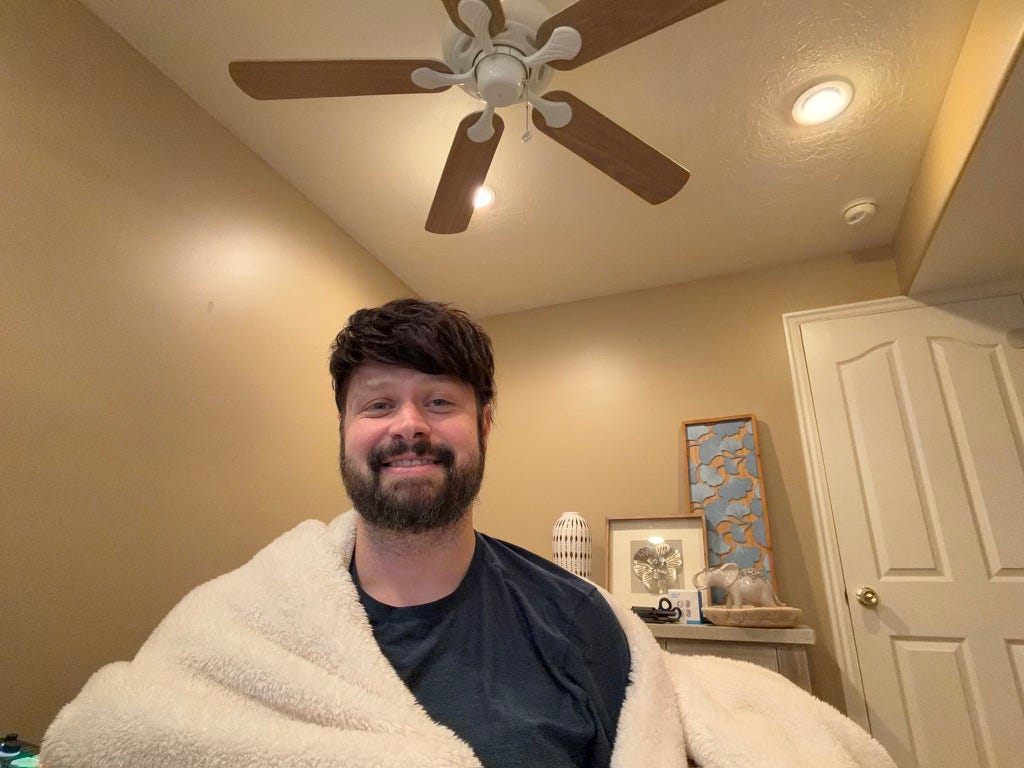
I’m Alex Lovell, PhD — political psychologist, yoga therapist, and the founder of a made-up institution called The Department of Aliveness.
By day I’m a VP leading global research on what makes people come alive at work. I love it. By every other random hour I’m here — writing, facilitating, and walking beside people who are figuring out what it means to be alive after everything shifted.
I’ve been homeless. I’ve been divorced. I’ve had my brain rewired by a semi-truck and my life rearranged by things I didn’t choose. I’ve also been surprised by how much aliveness was waiting in the wreckage — not because suffering is a gift, but because I stopped waiting to be healed before I started paying attention.
I’m on a mission to remind one person a day that the life they’re living is the one that counts.
Being a person who always took action to find a solution to a problem this story let me reflect on how very different I have been over these last few years. I still have the urge to solve a problem by using common sense in my responses and actions, but now not loudly nor rigid in what I think. I’ve mellowed I suppose in being able to hold myself back from being passionately involved. I’ve been trying to remind myself that although I still have my deep rooted belief that every individual has a choice to make a difference, it is no longer my quest to be that person that does. Saying that is a giant leap for me. I’ve always thought of myself as an independent centrist in the midst of politics. In my small personal life world … I am still empathetic and want to help my family in need, but no longer jump at the issues. I realize I don’t have an influential voice in the world yet to be completely silent especially in my physical circumstance is a daily struggle to hold back. Sometimes I succeed and sometimes I fail, but neither affects me anymore. I can’t honestly say I’m content, that would be a lie. I am aware though, alive and breathing, wishing the best all around for everyone’s problems, I am simply not trying to solve them anymore. Thanks for nudging me Alex to assess myself and realize who I am today.
Great reminder to stay focused, grounded, and not feel compelled to respond.