


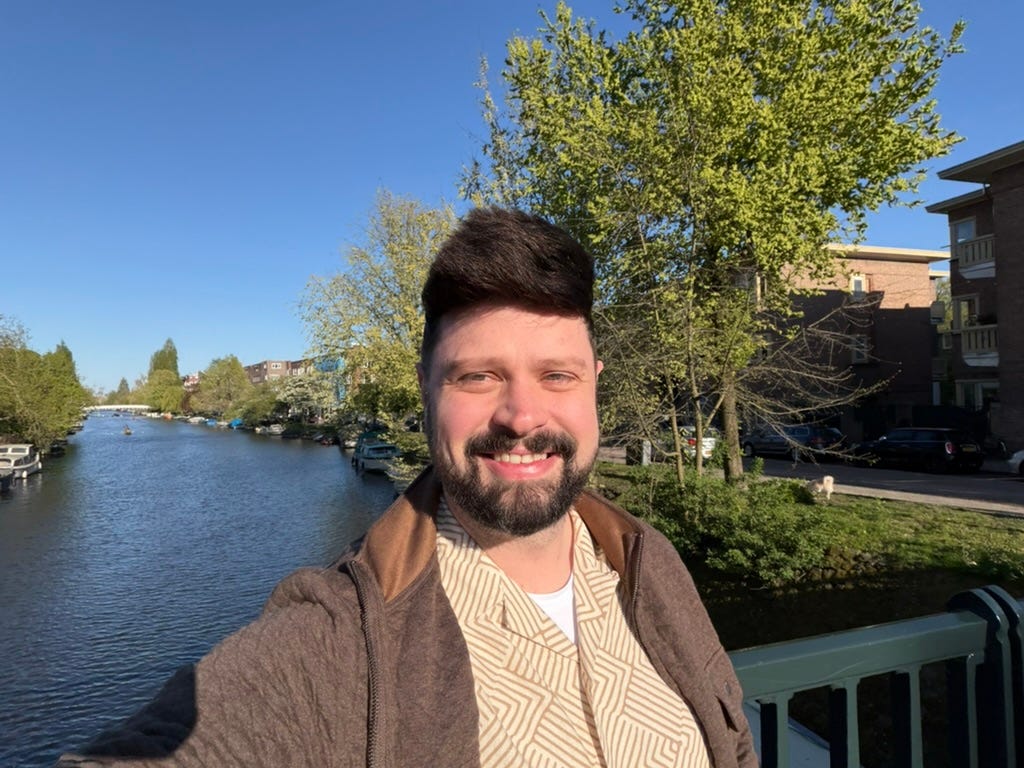
It’s 5:17 in the morning in Amsterdam and the canal outside is doing something I didn’t know canals did. A soft liquid knocking, like someone testing a door. My body thinks it’s yesterday evening. The kettle in this apartment has instructions in Dutch and I’ve been staring at it long enough that the word koken has stopped meaning anything, if it ever did. Helix and Poppy are ten hours away. Luis is asleep. The bed here is too firm in a way I’ll still get used to by the time I just leave.
And I’ve done this to myself on purpose.
That’s the part I keep coming back to.
I bought a ticket. I packed a bag. I agreed to be this loose in my own skin for five days. And yet the looseness itself, the particular quality of being unmoored from my routine and my dogs and my person and the angle of light in my own kitchen, feels almost identical to a looseness I did not choose, twice, years ago now. Once when a semi-truck hit me and I could not find the word for spoon for three weeks. Once when a marriage ended and I woke up for eleven months in a house that was becoming less ours by degrees, like a photograph left graying and curling in the sun.
The aliveness is the same. The aliveness of unmooring is the same whether you boarded the plane or the plane boarded you.
If you've ever felt your life come loose and needed language for it, subscribe now.
The Wrong Light
By six the light is coming through wrong. Not wrong exactly, just different in a way my body notices before my brain catches up. Grayer. Lower. Almost filtered through all that canal water somehow.
I make the coffee badly. Apparently, even fancy European coffee tastes terrible in a hotel room.
I sit by the window in a bathrobe someone else washed. A man in a long coat walks a small dog past the canal and neither of them look at me, which is why I request high floors. To be a body in a window. To have no one need anything from me for five days.
Here’s the thing I keep trying to name.
I am more alive to this badly-made coffee and this gray light than I’ve been to a morning in weeks. And I am duller. Heightened and muffled at once. The part of me that usually narrates my life back to me as it’s happening, you know the part, the one that says oh, this is nice or save this for later, that part is off. The coffee is just coffee. The light is just light. Sharper and slower. No voiceover.
I came here to do a job. Show up at a conference room. Say a few things about the future of work. Eat delicious food (and I had the most amazing Dutch Apple PIE). Fly home tired and a little proud of myself.
I did not come here to be emptied out.
But something empties when you leave the life you know. Even for five days. Even on purpose. Even with the return ticket already in your phone.
And I have been here before.
Seventeen
The first time I was unmoored without choosing it, I was seventeen and my parents told me to leave.
I’ve written about the park before. The one in Salt Lake where I turned eighteen. Luis and I rode past it on scooters and I said it out loud for the first time in a long time. Then we kept riding because the sun was out and the convention was ahead of us. That’s what being alive long enough lets you do.
I’m not going back to that park in this essay. I’m going to the months before that early birthday. The ones I don’t talk about much.
I was unmoored the way you are unmoored when the people who were supposed to keep you safe decide you are the thing to be kept safe from. I was unmoored from a house, a bed, a last name that meant something in the town I grew up in, a future I had been quietly assembling for years. I was unmoored from the idea that I could predict what adults would do.
I was unmoored from Sunday dinner after church.
The world got sharper. The way a world gets sharper when you don’t know where you are sleeping. I noticed every doorway I walked past and every car that slowed down near me. The smell of a specific kind of laundry detergent could flood me, because it was the detergent someone’s mom used, and I could tell just from the smell that she was a mom who would let me in if I asked. I did not ask. But I noticed.
And the world got duller. Food stopped tasting like much. Hours stopped meaning much. Whole days arrived and left, and I would not be able to tell you what happened in them, not because I was dissociating in some clinical sense, but because there was nothing in them to hold onto. Nothing to mark time against.
Sharper and duller. Both. At once. At seventeen.
I did not have the word for it then. I do not think there is a good word for it now. But the shape of what I was feeling is the same shape I am feeling in this Amsterdam room, watching a stranger walk a small dog past a canal.
To be clear. I am not saying being kicked out of my house at seventeen was like a work trip in Amsterdam. I am saying the human phenomenon of being unmoored, that specific quality of consciousness that arrives when you are loose from the life you knew, did not know the difference between what I had chosen and what had been done to me. My nervous system was not checking the paperwork.
It was only showing up the way it always has.
The Paperwork
It showed up when a car hit me. It showed up when a marriage ended. It has shown up in smaller ways I am not going to catalog here, because the point is not the catalog.
The point is that I am in a hotel room in Amsterdam that I chose and that I will leave tomorrow morning with a suitcase and a return ticket, and I am feeling the same looseness in my chest that I have felt at various points in my life. The volume’s different. The duration’ss different. The paperwork’s different. The looseness is the same.
I used to think the involuntary unmoorings were the real ones and the chosen ones were a pale imitation. Travel as a kind of low-dose version of the real thing. A rehearsal.
I don’t think that anymore.
I think the nervous system has one response to the life you knew coming loose from you, and it does not care how the looseness got there. It just registers the looseness. It just makes you more alive to the bad coffee. It just turns off the voiceover. It just leaves you sitting in a bathrobe in a country that isn’t yours, watching a man and a dog who will never know you walk past a canal that has been there forwho know’s how long.
The Permit
Here is what I want to say before I close the laptop and go find breakfast.
If the unmooring came for you without your permission, if you are inside one right now, the slow kind or the sudden kind, I want you to know the aliveness you might be feeling underneath the grief or the fear or the disorientation is not a betrayal of what you’re losing. It is your nervous system doing the only thing it knows how to do when the life you knew comes loose. It is showing up. It is turning the volume up on the bad coffee. It is letting you feel the light on your face a little more than usual, even now, even here.
And if you are not inside one, if your life is intact and ordinary and yours, you do not have to earn your unmoorings either. You do not have to have survived something to deserve the aliveness that comes from being loose in your own life. You are allowed to buy a ticket. You are allowed to drive somewhere you’ve never been for no reason. You are allowed to sit in a coffee shop in your own city at a time of day you don’t usually sit in coffee shops and feel the scaffolding come down a little.
That is not a lesson. That is just what is true.
The canal is still doing its soft knocking. The coffee is still bad. The kettle still has instructions I am choosing not to read.
I am unmoored. I am alive. Both. At once.
-Alex 🧡
If you thought of someone while reading this, that’s probably who it’s for. Send it to them.
About Alex
I’m Alex Lovell, PhD — political psychologist, yoga therapist, and the founder of a made-up institution called The Department of Aliveness.
By day I’m a VP leading global research on what makes people come alive at work. I love it. By every other random hour I’m here — writing, facilitating, and walking beside people who are figuring out what it means to be alive after everything shifted.
I’ve been homeless. I’ve been divorced. I’ve had my brain rewired by a semi-truck and my life rearranged by things I didn’t choose. I’ve also been surprised by how much aliveness was waiting in the wreckage — not because suffering is a gift, but because I stopped waiting to be healed before I started paying attention.
I’m on a mission to remind one person a day that the life they’re living is the one that counts.
Alex, I love the cadence of this piece...the way the looseness comes alive in your writing and in the reminding us all that the sense of being unmoored is ours for the asking/taking any time. Meaning that we can step out of our Identities, our Solidness, and be more present to the fluidity of noticing how we can and most often do feel two states of being at the same time. Stepping outside our routines can open us in such simple ways. I know how much I stay in my comfort zone of familiar routines. Thanks for the reminder to choose something new more often.
It comes without permission. Those we give permission to are not the same. Thank you for this kind of remembering. I remember times of being unmoored, not by permission but by force of circumstances. That same feeling of being cut loose and untethered. The not knowing, and in my case, not caring, what would come next. Always love your work. Love, Virg