


You’ve spent a long time getting ready to live.
Reading the books. Doing the work. Healing the thing so you could finally get to the life on the other side of it. And maybe you’ve started to suspect what no one in the healing industry will say out loud: there is no other side. There’s just this — your actual life, happening now, with all of it still on you.
The Department of Aliveness was built for that moment of suspicion.
I’m Alex Lovell. 👋
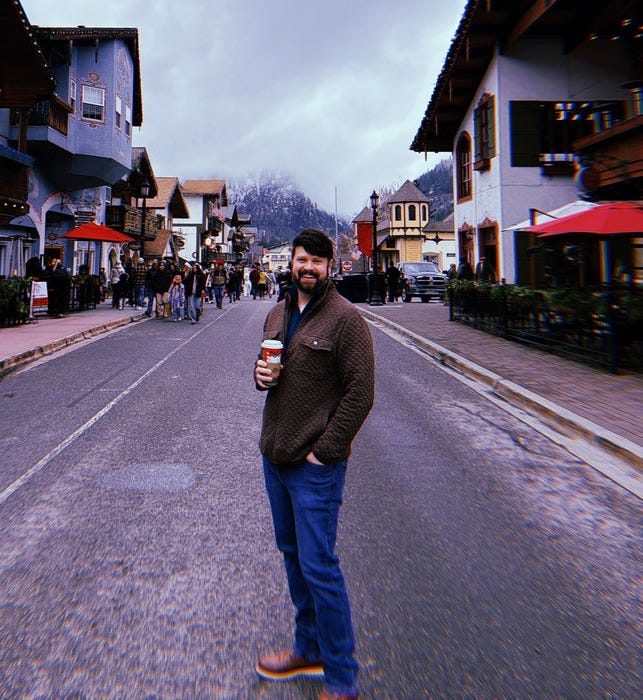
I’m a political psychologist, a yoga therapist, and a writer. I hold a PhD and I work as VP of the O.C. Tanner Institute, where I lead research on what makes people come alive — not in a motivational-poster sense, but in a ten-thousand-interviews, talk-to-real-humans-about-their-actual-lives sense. The pattern I keep finding is simple and uncomfortable: we’re most miserable when we’re performing, and most alive when we stop.
I also know this from the inside.
At seventeen I came out, got kicked out, and kept going with a backpack and a stubborn heartbeat. Later came divorce — the end of a future I’d already furnished in my head. Then a seven-car pileup with a semi that left me with a traumatic brain injury and the particular humiliation of having to relearn how to trust your own mind. I’ve been homeless. I’ve been raped. I’ve been in waiting rooms where well-meaning professionals told me I was on a healing journey, and I’ve sat in my car afterward thinking: what if I’m not on a journey? What if I’m just here?
That question changed everything.
I stopped trying to get back to the old shape. I stopped treating my life like a rough draft. I started paying attention to what was actually happening — in my body, in my kitchen, in the ordinary Tuesday that nobody was going to write a memoir about — and I found something I wasn’t expecting. The aliveness was already there. It had been there the whole time. I’d just been too busy preparing to live to notice I was already doing it.
What I’m against:
I’m against the idea that you need to be healed before you’re allowed to live. I’m against treating yourself as a project. I’m against the billion-dollar industry that profits from convincing you that the version of you sitting here right now — reading this, breathing, heart beating — is a rough draft of someone better.
Healing is real. Growth is real. But somewhere along the way, they became prerequisites for living rather than things that happen while you live. And that reversal is the quiet lie underneath all of it — the self-help books, the wellness content, the optimization culture, the therapeutic homework. They all say the same thing in different fonts: not yet. Almost. Keep working. You’re not ready.
You’re ready. You’ve been ready. The readiness was never the problem.
What I’m for:
Living now. Today. In this body, in this mess, in this kitchen, in this grief, with this heartbeat. Not because everything is fine — it probably isn’t — but because the alternative is spending your whole life in the waiting room of your own existence, and that is no way to be alive.
The Department of Aliveness is a made-up institution I built because no real one was doing what I needed.
I needed a place that would take me seriously without asking me to improve. A place that understood the difference between surviving and performing survival. A place that could hold grief and Costco in the same hand — the breath you take before you cry and the one you take before you laugh, which sometimes turn out to be the same breath.
So I made one up. Gave it a name. Started issuing permits nobody asked for and writing field reports nobody required. Tender work in a sturdy wrapper. Not sanctioned by any government or academic body. Completely fictional. Completely sincere.
Then other people started showing up. Turns out the Department had more clients than I expected.
What happens here:
I write weekly. Sometimes it’s sharp — naming the quiet lies we’ve been handed about healing, productivity, and what a good life is supposed to look like. Sometimes it’s slow — a lived scene, a sensation, a moment I can’t stop thinking about, rendered with enough detail that you might find yourself in it.
I share practices that take 90 seconds or less. Not because brevity is a virtue, but because most people reading this are already stretched past capacity, and asking for a 30-minute morning ritual is just another demand wearing a wellness costume.
This is for people who seem fine on the outside but sense something deeper is missing. People who are grieving, caregiving, getting sober, starting over, falling apart, falling in love, or just trying to feel like a person in their own life. People who are allergic to programs and suspicious of anyone who claims to have arrived.
I don’t fix people. I don’t stand above any of this. I’m the Department’s only full-time employee, and I was its first client. I walk beside you — which enough readers have independently said that I’ve started to trust it as a job description.
What I bring to this:
During the day, I study what makes people come alive inside organizations. I’ve conducted thousands of interviews. I’ve built research programs that reach hundreds of thousands of people. I know what the data says about belonging, recognition, and the experience of being seen at work — which, it turns out, is the same thing people need everywhere else.
I’m also a yoga therapist. I co-facilitate the Creator Retreat for sensitive, serious Substack writers. I do integrative yoga therapy that draws on somatic practice and the radical idea that your body knows things your credentials don’t.
The combination is the point. Research names the pattern. Practice gives you a way to live inside it. I bring both because choosing between the head and the body is just another way of postponing the whole experience of being here.
Our culture:
Presence over performance. Showing up counts.
We witness. We don’t fix.
Consent first. “Pass” is always welcome.
Small counts. Two breaths. One sentence. A quiet check-in.
Sacred and ridiculous both belong here.
If you’re here, you belong. Take what you need. Come back when you can.
Prefer a private share? Hit reply. I read every note.
With love (and fictional paperwork),
Alex 🧡
